

Introduction
The print and publishing landscapes in East-Central Saskatchewan are undergoing a profound technological evolution. For businesses, community groups, and independent creators operating in the agricultural, retail, and industrial hub of Yorkton, selecting the right customization and printing methods is no longer a matter of simple aesthetics—it is a critical business decision that impacts product durability, brand perception, and operational margins. As local enterprises look to expand their promotional outreach, custom apparel lines, and industrial signage, two primary digital printing technologies have emerged as dominant solutions: Ultraviolet (UV) Printing and Dye Sublimation Printing.
When analyzing the benefits of UV Printing Vs Sublimation Printing in Yorkton Saskatchewan, one must look beyond the surface level of ink and substrate. Yorkton’s unique geographic and economic realities play a massive role in this technical comparison. Our local climate experiences extreme seasonal shifts—ranging from bone-chilling winters dropping below -40°C to hot, dry prairie summers exceeding +30°C. These intense environmental swings place immense physical stress on outdoor signage, commercial vehicle graphics, and industrial equipment labels. Concurrently, our vibrant agricultural sector, local sports franchises like the Yorkton Terriers, and bustling retail corridors along Broadway Street demand high-fidelity, long-lasting promotional items and team wear that can withstand constant use and laundering.
This comprehensive guide provides an exhaustive, highly technical comparison of UV printing and dye sublimation printing. Whether you are a marketing manager looking to procure durable outdoor signage, an apparel brand developer launching a new clothing line, or an industrial supplier requiring resilient asset tags, this deep dive will arm you with the precise engineering and economic insights required to make an informed, ROI-driven printing decision in the Parkland region.
Understanding UV Printing: Technology, Chemistry, and Capabilities
Ultraviolet (UV) printing represents a pinnacle of modern digital inkjet technology. Unlike traditional inkjet printing, which relies on solvents or water-based carriers that evaporate over time to leave pigment behind, UV printing utilizes a photochemical process to dry and bond the ink instantly. This process, known as ultraviolet curing, transforms liquid ink into a solid, highly durable film in a fraction of a second.
The Science Behind UV Curing
The core chemistry of UV printing lies in the formulation of UV-curable inks. These inks consist of liquid monomers, oligomers, pigments, and specialized compounds called photoinitiators. When the printhead deposits the liquid ink droplets onto a substrate, it is immediately followed by an intense beam of ultraviolet light emitted from high-intensity LED lamps integrated directly onto the carriage assembly.
When the photoinitiators are exposed to this specific wavelength of UV light, they undergo a rapid chemical reaction, generating free radicals. These free radicals instantly initiate polymerization, causing the monomers and oligomers to link together into a cross-linked polymer network. This transition from liquid to solid occurs almost instantaneously, locking the pigment in place and preventing the ink from spreading, bleeding, or absorbing deeply into porous materials. The result is an incredibly crisp, high-resolution image with exceptional edge definition and color density.
Substrate Versatility: Printing on Virtually Anything
One of the most profound operational advantages of UV printing is its substrate independence. Because the ink cures instantly on top of the material rather than needing to absorb into it or chemically react with it, UV printers can decorate almost any flat or slightly curved surface. This makes it an invaluable asset for Yorkton’s diverse commercial landscape.
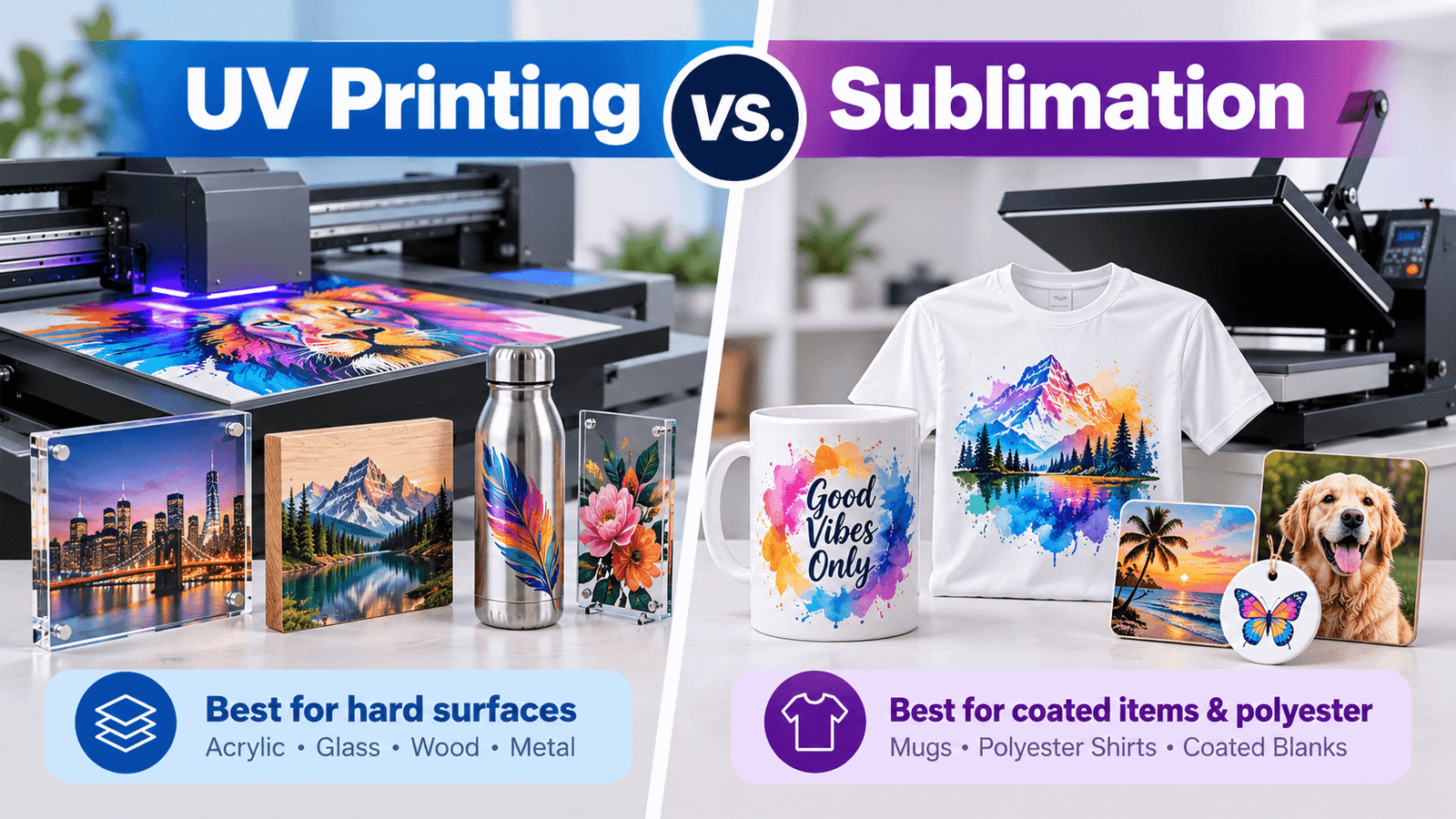
- Rigid Substrates: UV flatbed printers can print directly onto heavy-duty materials such as acrylic, PVC, aluminum composite panels (ACP/Dibond), corrugated plastics (Coroplast), glass, natural wood, and medium-density fiberboard (MDF).
- Flexible Substrates: High-end UV roll-to-roll systems can print on banner vinyl, window films, canvas, leather, and various synthetic membranes.
- Three-Dimensional Objects: Using specialized rotary attachments and adjustable-height flatbeds, UV printing can decorate cylindrical objects like insulated water bottles, golf balls, phone cases, and industrial control panels.
The Role of White Ink and Varnish
Unlike standard sublimation or traditional digital printing, which typically rely on the white background of the substrate to render bright images, UV printers frequently feature dedicated white ink channels. This allows for the printing of a high-opacity white underprint layer. Consequently, vivid, full-color graphics can be printed on dark, transparent, or highly textured surfaces—such as black acrylic, tinted glass, or raw wood—without losing color accuracy.
Additionally, many commercial UV printers utilize clear varnish or gloss inks. This clear coat can be applied as a flood layer to protect the entire print, or spot-applied to create dramatic textures, raised tactile patterns, and even braille lettering. This tactile capability adds a premium, high-value sensory dimension to printed products that sublimation simply cannot replicate.
Understanding Dye Sublimation Printing: Chemistry, Science, and Substrates
Dye sublimation printing is a highly specialized thermal transfer process that operates on the principles of molecular chemistry. Unlike UV printing, which deposits a physical layer of cured ink on top of a substrate, dye sublimation infuses the colorant directly into the molecular structure of the material itself. This results in a print that has zero physical feel (“zero hand”) and is virtually impossible to peel, crack, or wash away.
The Sublimation Process Explained
The term “sublimation” refers to the physical transition of a substance directly from a solid state to a gaseous state, bypassing the liquid phase entirely. In dye sublimation printing, this process is executed through a two-stage method:
- Digital Printing: A digital inkjet printer equipped with specialized sublimation dyes prints a mirrored version of the design onto a temporary carrier medium known as sublimation transfer paper. These dyes are formulated using solid, heat-sensitive dye particles suspended in a liquid carrier.
- Heat Pressing: The printed transfer paper is placed in direct contact with the target substrate (such as a polyester garment or a polymer-coated metal sheet). Both items are inserted into a heavy-duty heat press, which applies high temperature (typically between 180°C and 200°C / 350°F to 400°F) and substantial mechanical pressure for a specific duration (usually 30 to 60 seconds).
Under this intense heat and pressure, two critical physical transformations occur simultaneously. First, the solid dye particles on the transfer paper instantly sublimate into a highly reactive gas. Second, the polymer fibers (such as polyester) or the polymer surface coating on the substrate heat up, causing their microscopic pores to expand and open. The gaseous dye penetrates deep into these open polymer chains. As the heat press opens and the temperature drops, the polymer pores contract and close, trapping the dye inside. The dye reverts back into a solid state, permanently locking the brilliant color molecules inside the substrate’s matrix.
Substrate Restrictions: The Polymer Imperative
While UV printing excels at substrate versatility, dye sublimation is highly restrictive. Because the sublimation dyes can only chemically bond with synthetic polymers, this process is strictly limited to:
- Polyester Fabrics: Sublimation is the gold standard for 100% polyester apparel, performance wear, athletic jerseys, soft signage, and custom flags. It cannot bond with natural fibers like 100% cotton, wool, or silk. If attempted on cotton, the dye will wash out immediately.
- Polymer-Coated Hard Goods: Sublimation can be used on rigid materials like ceramic mugs, aluminum panels, glass coasters, and MDF plaques, but only if those items have been pre-treated with a specialized, optically clear polyester or polyurethane coating.
- White or Light-Colored Backgrounds: Sublimation dyes are transparent. Because there is no white ink option in sublimation printing, the background color of the substrate acts as the base. Printing a design on a black polyester shirt using sublimation is physically impossible, as the dark fabric will absorb the sublimated dye, rendering the print invisible. Therefore, sublimation requires white or pastel-colored materials for accurate color representation.
Direct Technical Comparison: UV vs. Sublimation
To fully grasp the practical differences between these two digital imaging giants, we must compare their technical performance, material capabilities, and economic profiles. When evaluating UV Printing Vs Sublimation Printing in Yorkton Saskatchewan, local buyers must weigh these parameters against their specific product applications.
| Technical Metric | UV Printing Technology | Dye Sublimation Printing |
| Primary Ink Chemistry | Liquid monomers, oligomers, and photoinitiators cured via UV light. | Heat-sensitive disperse dyes transferred via thermal gasification. |
| Substrate Range | Extremely broad (acrylic, metal, wood, glass, leather, PVC, etc.). | Strictly limited to polyester fabrics and polymer-coated rigid items. |
| Tactile Surface Feel | Raised, textured feel; ink sits on top of the surface. | Zero physical hand; ink is fully integrated into the substrate fibers. |
| White Ink Capability | Yes, highly opaque white ink allows printing on dark/clear materials. | No, relies entirely on a white or light-colored substrate base. |
| Outdoor UV/Fade Resistance | Exceptional; highly resistant to UV degradation and weathering. | Moderate; prone to fading over prolonged exposure to direct sunlight. |
| Washability & Wear | High on rigid goods; prone to cracking on highly elastic fabrics over time. | Permanent on apparel; will never crack, peel, or wash out. |
| Print Resolution & Detail | Ultra-high; up to 1200+ DPI with precise micro-droplet control. | High; continuous-tone photorealistic prints, but minor bleeding can occur. |
| Production Workflow | Direct-to-substrate; single-step process with immediate dry times. | Two-step process (print to transfer paper, then heat press). |
The technical divergence outlined in the table above highlights why these two methods are rarely in direct competition for the same product, but rather serve as highly complementary technologies within a comprehensive commercial print portfolio.
UV Printing in Yorkton: Industrial Strength for the Prairie Climate
For businesses operating in Yorkton, physical durability is a parameter that cannot be compromised. The local climate is notoriously unforgiving. Signage mounted on storefronts along Broadway Street or agricultural equipment deployed in the surrounding fields must endure blistering UV radiation, high winds, heavy snow loads, and rapid thermal cycling. This is where UV printing showcases its absolute supremacy.
Weatherproofing and Outdoor Durability
UV-curable inks are inherently robust. The cross-linked polymer chain formed during the LED curing process is highly resistant to chemical attack, physical abrasion, and moisture. More importantly, the pigments used in high-grade UV inks are formulated with organic and inorganic compounds that possess exceptional lightfastness. When exposed to the intense solar radiation of the Saskatchewan prairies, UV-printed graphics on materials like aluminum composite panels or exterior-grade acrylic can maintain their color saturation and structural integrity for years without fading, chalking, or delaminating.
Yorkton Industrial and Agricultural Applications
Yorkton serves as a major service hub for the agricultural and manufacturing industries of eastern Saskatchewan. These sectors require heavy-duty labeling, safety decals, and control panels that can withstand contact with diesel fuel, hydraulic fluids, grease, and mechanical wear. UV printing is perfectly suited for these industrial demands:
- Asset Tracking and Serial Plates: UV printing directly onto anodized aluminum or stainless steel sheets allows for the creation of high-contrast barcodes, QR codes, and serial numbers that remain legible under greasy, high-abrasion conditions.
- Agricultural Equipment Decals: Custom control panels, warning labels, and branding decals printed via UV flatbeds onto heavy-duty adhesive vinyl offer the necessary chemical and UV resistance required for field operations.
- Architectural Signage: Real estate signs, directional wayfinding markers, and exterior building directories printed on rigid Coroplast or Dibond can survive the punishing winter freeze-thaw cycles without cracking or peeling.
Dye Sublimation in Yorkton: Custom Apparel and High-Fidelity Promotional Merchandising
While UV printing dominates the rigid and industrial sectors, dye sublimation is the undisputed champion of the custom textile and high-fidelity promotional markets in Yorkton. From local hockey leagues to corporate branding campaigns, sublimation provides a level of comfort, detail, and vibrance that no other printing technology can match.
Custom Apparel and Team Sports
Yorkton has a rich sporting heritage, with numerous hockey, curling, soccer, and baseball teams requiring high-performance uniforms. Traditional screen printing or heat-applied vinyl transfers add physical weight to garments, block airflow, and eventually crack or peel under intense athletic use and repeated hot-water washing cycles.
Dye sublimation completely eliminates these drawbacks. Because the dye molecules chemically fuse with the polyester fibers, the fabric’s breathability, moisture-wicking properties, and elasticity are completely preserved. This is essential for performance apparel. A sublimated hockey jersey or athletic shirt features vibrant, full-color designs, sponsor logos, player names, and numbers that are completely integrated into the cloth. The graphics will not fade, peel, or crack, even after hundreds of trips through industrial washing machines.
High-Definition Photo Gifts and Soft Signage
Beyond apparel, sublimation is highly prized for its ability to produce stunning, continuous-tone photorealistic prints on rigid promotional items and home decor:
- ChromaLuxe Metal Prints: Sublimating high-resolution photography onto specially coated aluminum panels produces prints with breathtaking depth, vibrance, and a high-gloss finish. These are highly sought after by local artists, galleries, and corporate offices looking for premium wall decor.
- Promotional Drinkware: Custom ceramic mugs, stainless steel travel tumblers, and water bottles sublimated with corporate logos are staples of Yorkton business marketing campaigns, offering a durable, dishwasher-safe branding solution.
- Soft Signage and Trade Show Displays: Polyester banners, table covers, and tension fabric displays printed via sublimation are lightweight, wrinkle-resistant, and easily foldable, making them incredibly convenient for local businesses traveling to regional trade shows and community events.
Analyzing the Local Business Impact: ROI, Setup, and Turnaround Times
From an operational and procurement perspective, Yorkton business owners must evaluate the economic efficiencies of both printing methods. The return on investment (ROI) of a printing project is heavily influenced by run length, setup complexity, and material costs.
Setup Times and Labor Costs
UV printing is fundamentally a direct-to-substrate digital process. The preparation workflow is remarkably streamlined: a digital vector or raster file is loaded into the printer’s Raster Image Processor (RIP) software, the substrate is placed onto the flatbed vacuum table, the printhead height is calibrated, and printing begins immediately. There are no screens to expose, no transfer papers to print and align, and no post-cure heating cycles required. This makes UV printing incredibly cost-effective for short-run, highly customized, or variable-data print jobs (such as printing 50 distinct name badges or 10 customized safety signs).
Dye sublimation, conversely, is a multi-step process. It requires printing the design onto transfer paper, carefully aligning the paper with the substrate, securing it with heat-resistant tape, placing the assembly into a pre-heated press, executing the heat cycle, and manually peeling away the spent paper. This multi-stage workflow introduces more potential points of failure and increases labor costs per unit, especially for complex or large-format items. However, for high-volume apparel runs, automated roll-to-roll sublimation presses can achieve incredible speeds and highly competitive per-unit material costs.
Equipment Capital Expenditure (CapEx)
For local print shops considering expanding their in-house capabilities, the financial barrier to entry differs significantly between the two technologies. Commercial UV flatbed printers are complex, high-precision machines featuring advanced LED curing arrays, white ink circulation systems, and heavy-duty gantry mechanisms. Consequently, their capital acquisition cost is high, often requiring a substantial initial investment. This capital cost must be amortized over high-value, high-margin rigid printing contracts.
Dye sublimation systems have a more scalable entry point. Small-format sublimation printers and heat presses are highly accessible, allowing local boutiques and home-based businesses in Yorkton to enter the custom mug and apparel market with relatively low initial capital. However, industrial-scale, wide-format sublimation setups designed for high-volume textile production still require significant capital investment in specialized calender heat presses and high-speed printers.
Choosing the Right Method: A Decision Matrix for Yorkton Businesses
To help guide your next procurement cycle or creative project, we have synthesized a practical decision matrix based on common real-world scenarios faced by organizations in Yorkton.
Scenario A: You need 100 promotional pens, 50 acrylic awards, and 10 outdoor metal directional signs.
The Verdict: UV Printing. This project involves multiple rigid substrates (plastic, acrylic, and metal) and requires high-resolution detail on non-porous surfaces. UV printing’s direct-to-substrate capability and instant LED curing make this an efficient, high-durability, and cost-effective choice.
Scenario B: You need 200 custom-branded performance polo shirts for a local golf tournament and 50 custom ceramic coffee mugs.
The Verdict: Dye Sublimation. Because the apparel consists of performance fabrics (polyester), sublimation ensures that the shirts remain lightweight, breathable, and comfortable on the golf course. The ceramic mugs, pre-coated with polymer, will receive a vibrant, dishwasher-safe print that will not chip or scratch over time.
Scenario C: You need heavy-duty warning decals to place on agricultural seed drills and tractors.
The Verdict: UV Printing. These decals will be subjected to grease, oil, mechanical abrasion, and constant exposure to sunlight and weather. High-grade UV-cured inks printed on outdoor-grade cast vinyl provide the necessary chemical resistance and UV stability required to ensure safety labels remain legible for years.
Scenario D: You are setting up a trade show booth for a local agricultural manufacturing company and require a large, vibrant fabric backdrop.
The Verdict: Dye Sublimation. Sublimating onto tension fabric creates a rich, matte finish that does not reflect harsh exhibition lighting. The fabric backdrop can be folded, packed into a suitcase, and machine-washed if it gets dirty during transit, without any risk of the graphics creasing or cracking.
Key Takeaways
- Core Technology Difference: UV printing cures liquid ink instantly onto the substrate surface using intense ultraviolet light, whereas dye sublimation uses heat and pressure to gasify dye and infuse it into the molecular structure of polymers.
- Substrate Limitations: UV printing can decorate almost any flat or slightly curved surface (wood, glass, metal, acrylic, plastic). Sublimation is strictly limited to polyester fabrics and hard goods treated with a polymer coating.
- Environmental Resilience: UV printing offers superior resistance to weathering, direct sunlight, and chemical exposure, making it the premier choice for outdoor signs, industrial decals, and equipment labels in Yorkton’s harsh prairie climate.
- Apparel Superiority: Dye sublimation is unmatched for athletic and promotional apparel, yielding zero physical hand, complete fabric breathability, and permanent prints that can withstand endless washing cycles.
- Color Capability: UV printing features white ink channels, allowing for vivid printing on dark or clear materials. Sublimation cannot print white and requires a white or light-colored substrate base.
- Operational Workflow: UV is a fast, direct-to-substrate, single-step process ideal for short runs and rigid materials. Sublimation is a two-step transfer process that is highly efficient for high-volume textiles and custom drinkware.
Frequently Asked Questions
Is UV printing or sublimation better for custom apparel in Yorkton?
Dye sublimation is vastly superior for custom apparel, provided the garments are made of polyester or high-polyester blends. Sublimation fuses the ink into the fibers, maintaining fabric breathability and ensuring the design never cracks or peels. UV printing is not recommended for apparel as the cured ink sits on top of the fabric, resulting in a stiff, plastic-like texture that can crack when stretched.
Which printing method is more resistant to the cold Saskatchewan winters?
UV printing is exceptionally resilient against extreme cold and thermal shock. Because the ink undergoes a complete chemical polymerization, it bonds tenaciously to rigid substrates like aluminum composite panels and exterior acrylics, preventing the print from cracking, peeling, or lifting during Yorkton’s -40°C winter temperatures.
Can I sublimate onto 100% cotton t-shirts?
No. Sublimation dyes require synthetic polymers (like polyester) to open up and trap the gaseous dye molecules. Natural cotton fibers do not possess these polymer chains, meaning the dye will not bond and will wash out completely during the first laundry cycle. For cotton apparel, other methods like screen printing, direct-to-garment (DTG), or heat transfer vinyl are required.
Can UV printing produce textured or tactile effects?
Yes. Because UV ink cures instantly and sits on top of the substrate, a UV printer can build up multiple layers of clear varnish or white ink to create raised textures, embossed patterns, faux wood grain, wood-carved effects, and even fully compliant braille lettering. Sublimation cannot produce any tactile effects as the ink is completely absorbed into the material.
Is sublimation printing microwave and dishwasher safe?
Yes. When sublimation is applied to ceramic mugs or stainless steel bottles that have been pre-treated with a high-quality polymer coating, the design is locked beneath the surface. This makes sublimated drinkware highly resistant to heat and chemical detergents, making them completely safe for use in microwaves and residential or commercial dishwashers.
Are UV inks environmentally friendly?
Generally, yes. UV inks are considered more environmentally friendly than traditional solvent-based inks because they do not contain volatile organic compounds (VOCs) that evaporate into the atmosphere. The curing process is purely photochemical, meaning there are no harmful emissions or fumes generated during production, making it a safer choice for both operators and the environment.
Conclusion
When navigating the choices of UV Printing Vs Sublimation Printing in Yorkton Saskatchewan, it is clear that both technologies offer distinct, highly valuable solutions tailored to different market segments. UV printing is the undisputed powerhouse of industrial, agricultural, and outdoor signage applications, providing unmatched durability, chemical resistance, and material versatility in the face of Saskatchewan’s demanding climate. Dye sublimation, on the other hand, reigns supreme in the realm of custom apparel, high-fidelity promotional items, and soft signage, offering permanent, breathable, and photorealistic prints that capture the spirit of local sports teams and community brands.
For businesses and organizations in Yorkton looking to elevate their brand presence, optimize their promotional spend, or procure highly durable industrial graphics, partnering with a knowledgeable, technologically advanced print and design provider is essential. To explore how high-end design, digital branding, and state-of-the-art print technologies can transform your next commercial project, contact the regional experts at Pixel & Beam. By aligning the precise technical strengths of UV and sublimation printing with your strategic marketing goals, you can ensure your message not only survives the elements but stands out with exceptional clarity and impact.
Where are you located in Yorkton?
Hi Jamie, we currently don’t have a physical storefront in Yorkton, but we do offer local delivery and, in some cases, local pickup.
Is there anything in particular you’re looking for or something we can help you with? We’d be happy to help!