3D Laser Inner Engraving in K9 vs. K5 Crystal Glass
Discover how images are engraved inside crystal, the differences between K9, K5 and ordinary glass, and the steps that produce a clear, permanent 3D design.

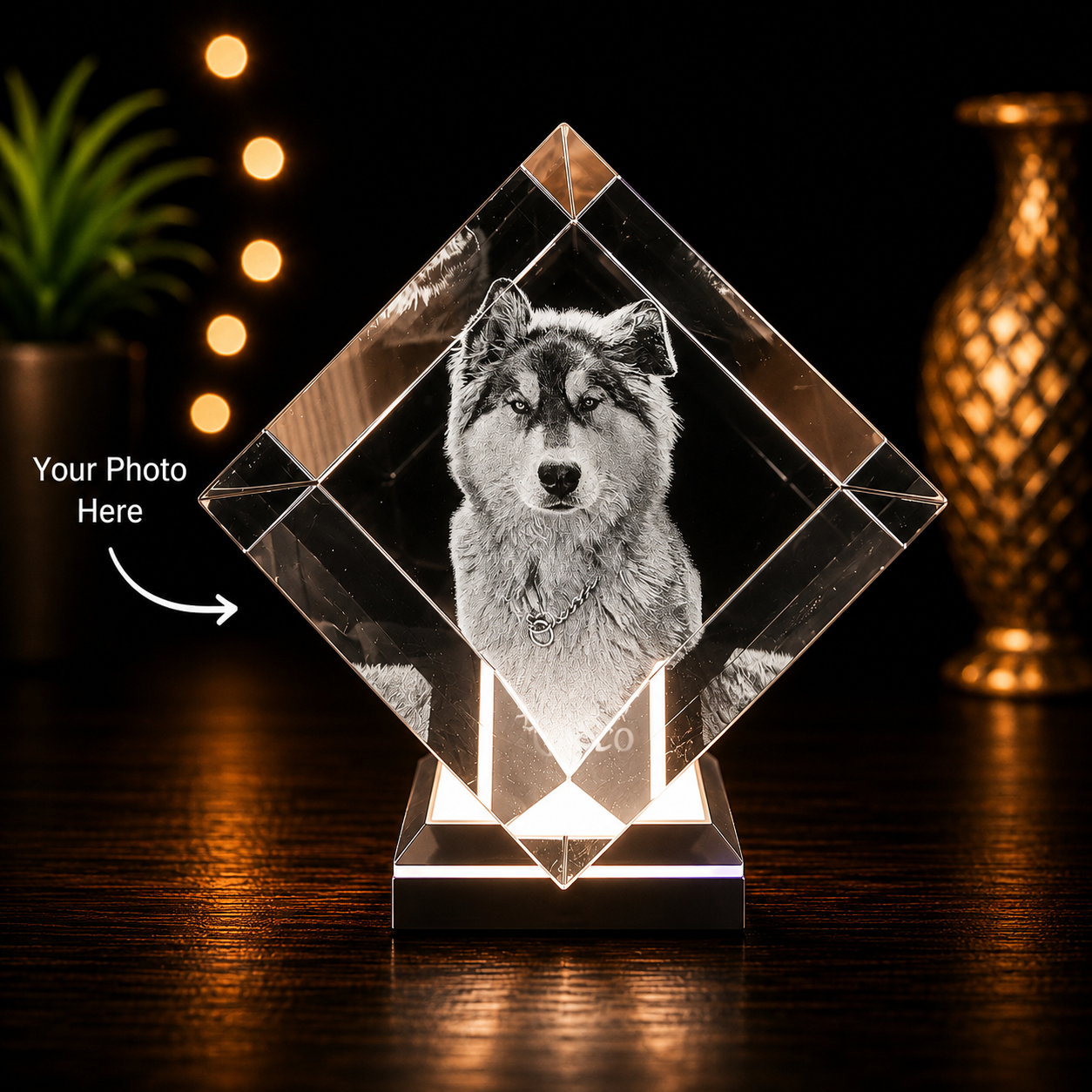
3D laser inner engraving turns a clear glass block into a personalized piece of art. Instead of marking the outside surface, a focused laser creates thousands—or even millions—of microscopic points inside the glass. Together, these points form a photograph, logo, message or three-dimensional model.
This process is also known as subsurface laser engraving, 3D crystal engraving or inner glass engraving. K9 and K5 crown glass are commonly used because a good-quality blank can provide the clarity and internal consistency needed for detailed engraving.
What Is 3D Laser Inner Engraving?
A subsurface engraving machine directs short laser pulses through the polished surface of transparent glass. The beam is focused at precise coordinates beneath the surface. At each coordinate, the concentrated energy produces a microscopic change or fracture point.
One point is barely visible, but thousands of carefully positioned points scatter light and build a bright image inside the glass. Because the laser is focused internally, the exterior stays smooth and the design cannot be rubbed or washed away.
- A photograph can be reproduced as a flat 2D image.
- Special software can convert suitable photos or scans into a 3D model.
- Text, dates, logos and decorative backgrounds can be added.
- An LED light base can make the engraved points appear brighter.
Is K9 Really Crystal?
K9 is an optical crown glass commonly compared with BK7-type optical glass. It is generally lead-free and should not be confused with traditional lead crystal. The word “crystal” is often used commercially to describe a clear, highly polished decorative glass product.
High-quality K9 offers good visible-light transmission and carefully controlled optical properties. It typically has low levels of bubbles, streaks and internal inclusions. These qualities make engraving-grade K9 an excellent choice for premium awards, portraits, memorials and illuminated 3D keepsakes.
What Is K5 Glass?
K5 is also a crown-glass designation. However, “K5 crystal” is sometimes used as a broad commercial grade in the gift industry. A product advertised as K5 may not meet a particular optical-glass standard, so it is important to request the supplier’s specifications and test sample blanks before buying a large quantity.
K5 blanks are often chosen for economical awards and promotional products. Their engraving performance depends on clarity, annealing, internal stress and consistency—not simply on the K5 name.


K9 vs. K5 vs. Ordinary Glass
| Feature | K9 Crown Glass | K5 Crown Glass | Ordinary Soda-Lime Glass |
|---|---|---|---|
| Common use | Premium crystal gifts and optical applications | Decorative blanks, awards or optical applications | Windows, bottles and household products |
| Internal quality | Usually well controlled when sold as optical-quality K9 | Can vary considerably by supplier and grade | Not necessarily controlled for subsurface engraving |
| Engraving detail | Excellent with a properly qualified blank | Good when the blank has suitable internal quality | Unpredictable unless made for inner engraving |
| Appearance | Clear and suitable for detailed 3D subjects | Clear, although quality may vary | May show more tint or visual distortion |
| Typical cost | Usually higher | Often more economical | Generally inexpensive |
| Best choice for | Premium portraits, memorials and detailed models | Awards, gifts and simpler commercial work | Surface engraving or specially tested applications |
Important: K9, K5 and ordinary soda-lime glass can have surprisingly similar refractive-index values. The real engraving advantage of a high-quality K9 or K5 blank comes from optical homogeneity, low bubble content, proper annealing, controlled internal stress and precise polishing—not refractive index alone.
Why Ordinary Glass May Give Poorer Results
Not every transparent object can be engraved internally with the same settings. General-purpose glass may contain internal stress, bubbles, streaks, inclusions or thickness variations. These imperfections can cause:
- Uneven dot brightness
- Distorted faces or fine text
- Random cracks or cloudy areas
- Inconsistent focus at different depths
- A greater risk of breaking the workpiece
Tempered glass should not be treated as an ordinary engraving blank. Its internal stress can make it unsuitable or unsafe for subsurface processing. Use blanks that your glass supplier or machine manufacturer specifically approves for inner engraving.
How to Make a 3D Crystal Engraving: Step by Step
 1. Choose Your Crystal
Select the shape, size and display style.
1. Choose Your Crystal
Select the shape, size and display style. 2. Upload Your Design
Send a clear photo, logo, text or artwork.
2. Upload Your Design
Send a clear photo, logo, text or artwork. 3. We Craft Your Piece
The design is prepared and engraved with precision.
3. We Craft Your Piece
The design is prepared and engraved with precision. 4. Delivered to You
Your finished crystal arrives protected and ready to display.
4. Delivered to You
Your finished crystal arrives protected and ready to display.1. Choose the Correct Glass Blank
Select a polished, engraving-grade K9 or K5 blank. Examine it under strong side lighting and reject pieces with visible bubbles, chips, scratches or internal lines. Confirm that the blank is compatible with your machine’s wavelength and focusing system.
2. Prepare the Photograph or Design
Start with a sharp, well-lit image that clearly separates the subject from the background. Portraits work best when the full face is visible and not hidden by heavy shadows, hair or accessories. Remove the background and retouch distracting details before engraving.
3. Create the 2D or 3D File
For a flat inner engraving, convert the photograph into the format required by your machine. For a true 3D result, create a depth model using multiple photographs, a 3D scan or specialist photo-to-3D software. Check facial proportions carefully because laser settings cannot correct a poorly shaped model.
4. Position the Design
Enter the crystal’s exact dimensions and center the model within the safe engraving area. Leave enough distance between the engraving and every exterior surface to reduce the risk of edge damage.
5. Set the Laser Parameters
Set the focal correction, point spacing, pulse energy and engraving speed for the specific material and block size. Do not copy settings blindly from another blank because different grades and suppliers can respond differently.
6. Run a Small Test
Use a sample blank to test point brightness, dot spacing, text readability, depth accuracy and unwanted cracking. A small test pattern can prevent the loss of an expensive production blank.
7. Engrave the Crystal
Clean the crystal and machine platform, position the blank securely and run the engraving program. Always follow the machine manufacturer’s laser-safety instructions. Never bypass the enclosure or safety interlocks.
8. Inspect and Finish
Inspect the result under lighting from several directions. Clean the outside with a lint-free cloth and package the finished crystal in a protective presentation box. Add an LED base if you want the microscopic points to appear brighter and more three-dimensional.
Advantages of Engraving Inside K9 or K5 Glass
A Permanent Design
The image is protected inside the glass. Normal handling cannot scratch or erase it because the engraving is not carried on the exterior surface.
A Smooth, Polished Exterior
Customers can clean and handle the piece without touching the engraved design, giving awards and keepsakes a refined finish.
Impressive 3D Depth
Laser points can be placed at different internal coordinates, allowing a 3D model to be viewed from several angles.
Excellent Personalization
Portraits, pets, buildings, products, logos, names, dates and personal messages can be combined in one design.
No Ink Is Required
The image is formed by light scattering from the internal points. An LED base can enhance the image without applying paint or ink.
Long-Lasting Display Value
When protected from impact, the internal design can remain visible for many years. This makes it ideal for wedding gifts, memorials, corporate awards and family keepsakes.
Tips for Better Engraving Results
- Buy blanks specifically approved for subsurface laser engraving.
- Keep a parameter record for every material, shape and supplier.
- Use high-resolution, front-facing photos for portrait work.
- Avoid placing dense engraving points too close together.
- Leave a safe margin around the design.
- Clean every surface before focusing the laser.
- Test each new batch of blanks before production.
- Photograph completed crystals against a dark background with side or base lighting.
Should You Choose K9 or K5?
Choose K9 when you need a premium presentation, dependable clarity and detailed portraits or 3D models. It is often the preferred option for high-value gifts and awards.
Choose K5 when cost is important and the supplier can demonstrate consistent engraving quality. A tested K5 blank can be a practical option for promotional items, simpler logos and production work.
Use ordinary glass only after confirming that it was manufactured and annealed for subsurface engraving. A lower purchase price does not compensate for broken blanks, distorted images or inconsistent results.
Frequently Asked Questions
Does the laser cut through the crystal?
No. The beam passes through the surface and focuses at selected points inside the glass, where it creates the visible engraving.
Can every glass object be engraved internally?
No. The object must be transparent, properly annealed and compatible with the laser system. Curved, tempered, tinted or internally stressed glass may require special calibration or may be unsuitable.
Is K9 better than K5?
K9 is commonly preferred for premium work, but a verified, high-quality K5 blank can outperform a poorly manufactured product labeled K9. Supplier quality and batch testing are essential.
Is K9 the same as lead crystal?
Usually not. K9 is generally described as lead-free optical crown glass. “Crystal” is frequently used as a marketing term for clear decorative glass.
Can a normal CO₂ engraver create a 3D image inside glass?
Generally, no. True subsurface engraving requires a machine designed to focus suitable laser pulses inside transparent material. A conventional CO₂ engraver normally marks the surface.
How many points are used in one engraving?
The number depends on the size and complexity of the design. A detailed 3D portrait may contain hundreds of thousands or millions of microscopic points.
Final Thoughts
Successful 3D laser inner engraving depends on the relationship between the laser, the digital model and the quality of the glass blank. K9 is an excellent choice for premium, highly detailed work. K5 can produce attractive, economical results when its specifications and performance have been verified.
Always test each new batch, optimize the laser settings and begin with a clean, well-prepared image. With the right combination, a simple transparent block can become a permanent 3D memory preserved inside glass.
Ready to turn your photo into a personalized 3D crystal? Contact Pixel & Beam Creations to discuss your photograph, logo, award or custom design.
Technical references: SCHOTT Optical Glass Technical Details and SCHOTT N-K5 Optical Glass Datasheet.